OVERLAND TELEGRAPH & Wm T Dalwood
The Overland Telegraph project was an incredibly bold venture by the government and people of the colony of South Australia. At huge expense and personal sacrifice of many, a telegraph line was constructed from Port Augusta in the south to Darwin on the northern extremity of the Australian continent. It was to connect with a submarine telegraph cable to be “landed” there.
William Trevett Dalwood's Role
My (Ian Dalwood's) grandfather's uncle, William Trevett Dalwood, and his partner Joseph Darwent were the contractors for the construction of the northernmost 600 miles (965 kilometres) of the line. The contract was awarded amidst some controversy, and after considerable work had been done, it was annulled amidst even more controversy. William spent several years pursuing compensation, with limited success.
About the Line
The line linked Australia to London and the rest of the world. On completion, messages took only hours rather than months to reach Australia. Before the line was constructed, the Australian continent had been crossed north/south only by intrepid Scotsman John McDouall Stuart. In the preface to his Explorations in Australia: The Journals of John McDouall Stuart, published in London in 1864, he claimed that a route through the interior could be used for a telegraph line.
In the words of Charles Todd, (later Sir Charles), South Australian Postmaster General and planner and prime mover for the project: "The work was authorised by Parliament in [June] 1870, and completed in August 1872. The line was carried from Adelaide to Port Darwin, a distance of nearly 2,000 miles [3,200 km] and it went through at least 1,500 miles [2,400 km] of terra incognito, except what we knew from Stuart’s valuable reports. The route the great explorer took was adopted."
Harriet Douglas, the daughter of the Government Resident in the Northern Territory at the time, later, as Mrs Dominic D Daly, wrote about the difficulties, in her book Digging, Squatting, and Pioneering Life in the Northern Territory of South Australia. She wrote: "I, who was on the spot for nearly twelve months while the work was going on, can testify to the troubles and dangers the constructing party our end had to face", Mrs Daly rammed the earth round the base of the first pole with a ceremonial rammer specially made of hard polished wood, and is person number 7 in the first pole photograph.
Captain Charles Sturt's Sextant
A unique, small brass sextant in a wooden case was used during the construction of the Overland Telegraph. The sextant had been given to Caleb Dalwood by Captain Charles Sturt. Caleb was William Trevett Dalwood's father and my (Ian Dalwood’s) great great grandfather.
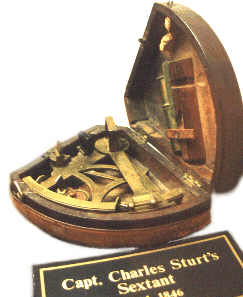
Sturt, a very popular and respected man, was a British soldier and explorer. He lead major expeditions into inland Australia and used the sextant during central Australian explorations in 1844-1846. He mapped key river systems, discovered the Darling and Murray rivers, and searched for a rumoured inland sea. He had been Surveyor-General, succeeding Colonel William Light (the now much-revered surveyor and planner of the city of Adelaide). Sturt was appointed Colonial Secretary of South Australia in 1849. The original establishment of the colony of South Australia owed much to Sturt's enthusiastic reports from his earlier explorations in 1829.
The sextant was on display in the Museum of Australian Surveying at National Surveyors House in Canberra. However it now appears to have been sold at auction to an unknown buyer in February 2026.
There is a lot more to be told about the Overland Telegraph and William Trevett Dalwood's involvement both at the time of construction as well as for several years afterwards...
OVERLAND TELEGRAPH – FIRST POLE
“Planting” the First Pole of the Northern Section
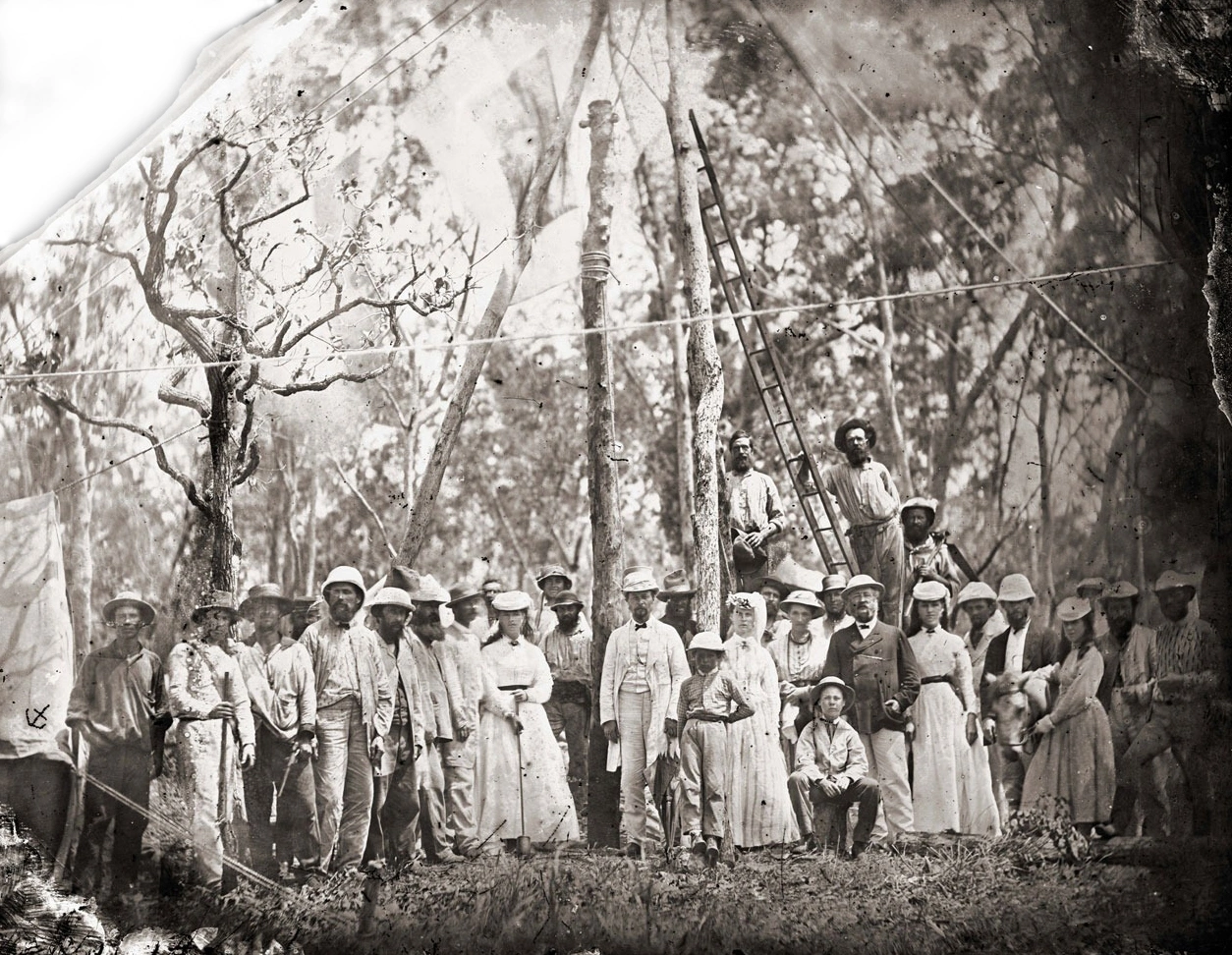
Planting the first pole of the North-South Transcontinental Telegraph Line 15 September 1870
According to Sydney Wellington Herbert, the people pictured are (mostly the front row):
1. un-named
2. W. M. EDWARDS, stockman
3. E. PALMER, cook
4. Mr BURTON, second in command for the Government
5. Dr FURNELL, medical officer of the expedition
6. Mr DALY, son of the late Governor DALY (half visible, including hand)
7. Miss DOUGLAS, later Mrs DALY
8. pole
9. Mr DALWOOD, contractor (in light-coloured clothes)
10. young Master DOUGLAS
11. Mrs DALWOOD
12. Mrs PACKARD (at rear)
13. Master DALWOOD (seated, at front)
14. Captain DOUGLAS, Government resident
15. second Miss DOUGLAS
16. Mr PAQUALINE, in command of contract (at rear, part hidden, white hat)
17. Mr McMINN, Chief Government Inspector (in helmet)
18. Young Miss DOUGLAS and pony
19. Mr STAPLETON, telegraph operator (dark face)
20. Mr DARWENT, second in command for the contractors
The rear of the photo is inscribed: "Among those present were:
Mr Palmer, Mr Burton, Dr Furnell, Dr Millner, D.D. Daly, Miss Douglas, Mr & Mrs William Trevett Dalwood, Willie Douglas, A.T. Childs, Captain & Mrs Douglas, F.W. Dalwood, Miss Douglas, W. McMinn, Miss B. Douglas, Mr James Darwent, J. McKinlay, Mr Grey, Mr E. Holthouse, Mr Davis, Mr Paquelin.
Time: 3:00 pm."
The photographer (Captain Samuel Sweet) was the Master of the GULNARE which had brought the OT contractors Darwent and Dalwood and their men and materials to Darwin. He took many notable photographs throughout the colony of South Australia
Reminiscences of S W Herbert
Sydney Wellington Herbert recording in his diary the erection of the first pole, identified the people in the photograph (as listed above, in order left to right). He described the occasion:
"September 16th [he appears to have erred by one day]
"The first telegraph pole was erected on this date at the south-east end of Cavanagh Street Palmerston, in the presence of the Government Resident and family, Mr and Mrs Dalwood, the officers of the expedition, and local residents. A lithograph of this interesting scene reproduced on the opposite page.
"Mrs Dalwood broke a bottle of wine over the pole and drove in the first insulator pin. The pole was then raised to an upright position in the hole, and Miss Douglas had the honour to ram the earth round its base with a rammer (made for the occasion) of hard polished wood."
Sources

The photograph was obtained via the Library & Archives Northern Territory website (PH0238/0383). It is also on the State Library of South Australia website (B 4638).
S. W. Herbert's diary is in the State Library of South Australia (ref. number D 6995/4(L)).